Preparing artwork for custom playing cards comes down to four pieces: a back design, the card faces, the tuck box and any extra cards. Get Custom Playing Cards needs only your logo or rough idea to start, returns a free mockup within 24 hours, and offers unlimited free revisions, so you approve every card before a single deck is printed.
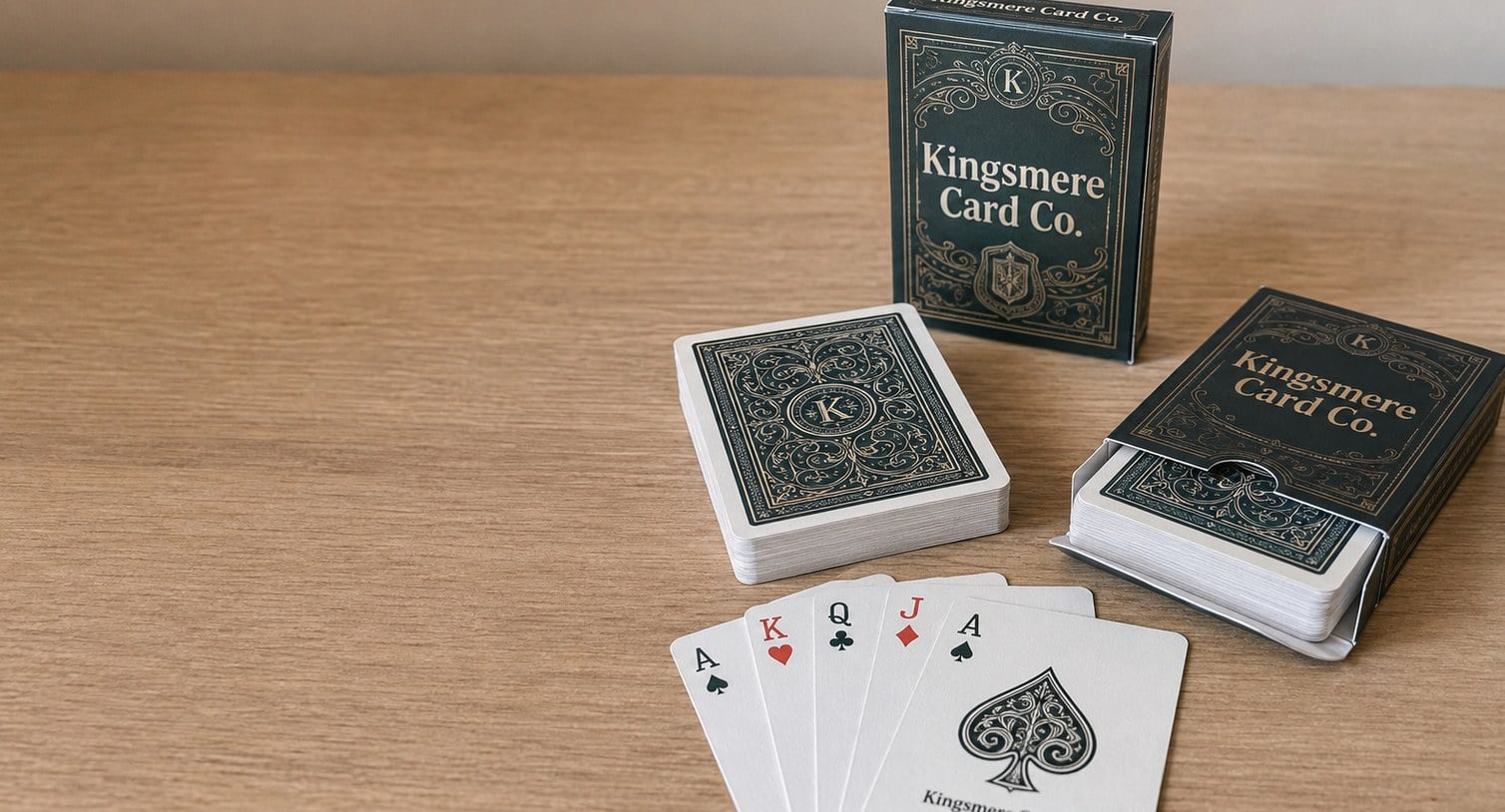
- A custom deck has four artwork zones: back, faces, tuck box and extra cards
- Free mockup within 24 hours of your request
- Unlimited free revisions and nothing to pay until you approve the design
- Minimum order of 12 decks
- Standard turnaround about 2 weeks after approval
What artwork do you actually need to start a custom playing card order?
To start a custom playing card order, you need far less than most buyers expect: a logo, a brand color or two, and a sentence about how the deck will be used. Get Custom Playing Cards builds the first mockup from that, so you do not need a finished, print-ready design before you ask for a quote.
What helps most is context. A deck handed out at a conference booth, a deck mailed to clients as a holiday gift and a deck built for a casino night all call for different artwork decisions. Tell the team who receives the cards, whether they will actually be played, and whether you want only a branded back or a fully custom card deck with designed faces.
Useful things to gather before you request a quote:
- Your logo in the best version you have, ideally a vector file from whoever designed it
- Brand colors, named the way your brand guide names them
- Any photos, illustrations or taglines you want on the faces or the box
- Notes on what must not change, such as logo proportions or a required disclaimer
- Your event date, so the timeline can be planned backward from it
Which parts of a custom deck can carry your artwork?
Every part of a custom deck of playing cards can carry artwork, but each zone has a different job. The back sells the brand every time a card is dealt, the faces carry the game, and the tuck box is the first thing a recipient sees. Deciding which zones to customize is the biggest artwork decision you will make.
| Artwork zone | What it does | Typical approach |
|---|---|---|
| Card back | Shown on every card during play | Logo, pattern and brand colors, designed to look identical from both directions |
| Number cards | Carry the pips and indices players read | Standard faces, or custom pips and colors on fully custom decks |
| Court cards | Kings, queens and jacks | Classic illustrations, or custom characters, products or team members |
| Ace of spades | The traditional signature card | Often the spot for a large logo or a message |
| Jokers | Free space with no game role in most games | Mascots, QR codes, taglines or contact details |
| Tuck box | Packaging and shelf presence | Logo, deck name and colors that match the back |
If you are unsure which route fits, the comparison of standard vs. fully custom playing card decks walks through the trade-offs.
How should a custom playing card back be designed?
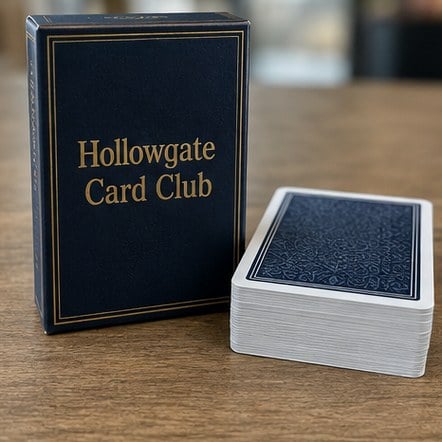
A custom playing card back should be designed so that no single card can be identified from behind. That means the artwork looks the same when a card is rotated, carries no off-center elements, and uses a pattern or framed composition that hides the small shifts that happen when sheets are cut.
The safest back designs share a few traits. A centered logo inside a border or repeating pattern reads clearly across a table. Mirrored artwork, where the top half is flipped to form the bottom half, keeps the deck fair for real games. A border in a contrasting color, or a full-bleed pattern, both work, and the mockup will show you how the edges look before anything prints.
Things that cause trouble on backs:
- A one-way photo or a logo with text that reads correctly only one way up
- A thin border hugging the edge, which exaggerates any small trim variation
- Large areas of flat pale color, which show handling marks quickly
- Tiny details that disappear when the card is held at arm’s length
Get Custom Playing Cards checks back artwork for these issues during the mockup stage and suggests adjustments before you approve anything.
How do you keep custom card faces readable during a game?
Custom card faces stay readable when the corner indices are left clear and high-contrast. Players fan their cards and read only the corners, so any artwork that crowds or overlaps the rank and suit in those corners slows down play, no matter how good it looks in a mockup.
The center of each card is where custom faces have room to breathe. Products, illustrations, team photos or themed characters can live there, as long as the suits still read at a glance. Keep hearts and diamonds clearly distinct from spades and clubs. If your brand palette replaces the traditional red and black, make sure the two suit colors are still easy to tell apart under dim party lighting.
For decks that will be played by older guests or in low light, a bridge-size deck or a large-index layout gives the indices more space. For games like poker, where cards are held and squeezed, the classic custom poker deck proportions are the better base for your artwork.
A quick readability test
- Print a page of your face designs at home and cut out a few cards.
- Fan them in one hand and read only the corners.
- Lay them face up across a table and check the suits from a standing position.
What makes logo artwork print cleanly on playing cards?
Logo artwork prints cleanly on playing cards when it starts as a vector file, uses defined brand colors and avoids hairline details. Vector files such as AI, EPS, SVG or a vector PDF scale to any size without blurring, which matters because the same logo may appear large on the box and small on the card back.
If you only have a JPG or PNG, send it anyway. Get Custom Playing Cards will tell you during the mockup stage whether the file is sharp enough or whether the logo should be rebuilt, rather than letting a soft image go to press.
- Colors: name your brand colors as they appear in your brand guide so the mockup can match them as closely as print allows. Very bright screen colors can look slightly calmer in print.
- Fine lines and small text: thin strokes and tiny taglines can fill in or vanish at card size. Simplify the logo or move the tagline to the box.
- Gradients and glows: soft effects can band or look muddy. Flat color usually reads stronger on a card.
- Dark solids: deep, full-coverage backs look rich but show edge wear sooner on heavily played decks. A plastic deck holds up better if the cards will see real use.
How does the mockup and proof stage work?
The mockup and proof stage is where your custom playing cards are designed, checked and approved before production. Get Custom Playing Cards sends a free mockup within 24 hours of your request, showing the back, sample faces and the box so you can judge the deck as a whole rather than as loose files.
From there, revisions are unlimited and free. You can swap colors, move the logo, try a different back pattern or rework the court cards as many times as you need. You pay nothing until you approve the design, so the proof stage carries no financial risk.
- Request: share your logo, notes and quantity, starting from a minimum of 12 decks.
- Mockup: receive a free visual within 24 hours.
- Revise: request changes until every card looks right.
- Approve: sign off on the final proof and confirm the order.
- Produce: standard turnaround is about 2 weeks after approval, with faster turnaround available through express shipping.
See the full how it works page for the ordering steps after approval.
What artwork mistakes should you avoid on a custom deck?
The most common artwork mistakes on a custom deck are proofing only the back, approving without checking every unique card, and forgetting the tuck box. Each one is easy to avoid if you review the mockup the way a recipient will actually use the deck.
- Skipping the faces: on fully custom decks, check every card for spelling, suit and rank, not just a sample.
- Dated artwork on a long-life deck: a year or event date limits reuse. Put dates on the box or a joker instead of the back.
- A box that does not match: plan custom tuck box artwork together with the back so the deck feels like one product.
- Too many approvers too late: collect feedback from everyone who must sign off during the first round of revisions, not after the final proof.
- Wasted joker space: jokers and the ace of spades are free branding space. Use them for a website, QR code or message.
If your deck is a gift, the same checks apply to the details recipients notice first, which the custom playing cards for corporate holiday gifts page covers in depth.
Frequently asked questions
Can my logo replace the suit symbols on custom playing cards?
Custom playing cards can use your logo in place of the traditional suit symbols on a fully custom deck. The logo needs four clearly different versions or colors so players can still tell the suits apart at a glance. Get Custom Playing Cards shows the result in the free mockup, and simple, bold logos usually work better than detailed marks for this approach.
Should the ace of spades get special artwork in a custom deck?
Playing cards have long used the ace of spades as a signature card, so many custom decks place a large logo, a crest or a short message there. Special artwork on that one card adds a memorable detail without changing how the rest of the deck plays. Get Custom Playing Cards can design it alongside the back so the two pieces of artwork feel related.
Can the jokers in custom playing cards have their own design?
Custom playing cards can give the jokers a completely different design from the rest of the deck, because jokers play no role in most games. Brands often use them for a mascot, a website, a QR code or a thank-you note. The two jokers can match each other or carry two separate messages, and both appear in the mockup for approval.
How should I share brand colors for a custom deck of playing cards?
Playing cards match brand colors best when you name each color exactly as your brand guide lists it, or send the guide itself. Screen colors and printed colors never look perfectly identical, so the mockup is the place to flag anything that feels off. Get Custom Playing Cards adjusts the artwork through unlimited free revisions until you are satisfied with the color direction.
Will small text in my logo stay legible on playing cards?
Playing cards are small, so thin taglines and fine lettering inside a logo can blur or fill in once printed. A simplified version of the logo, without the tagline, usually reads better on the card back. Get Custom Playing Cards points out legibility concerns during the mockup stage and can move small text to the tuck box, where there is more room.
What happens if my playing card artwork file is low resolution?
Low-resolution artwork for playing cards can look soft or pixelated, especially on the tuck box where the logo prints larger. Send the file anyway, because Get Custom Playing Cards reviews every file during the free mockup stage and tells you whether it will print cleanly. If it will not, the team explains the options before you approve anything or pay for the order.
Can I design only the backs and keep standard faces on my playing cards?
Playing cards with a custom back and standard faces are the most common way to brand a deck. Every card carries your logo whenever it is dealt, while the familiar faces keep play quick for every guest. The approach also shortens design review, since only the back, box and any special cards need approval. Promotional decks and giveaways often use exactly this setup.
Who checks custom playing card artwork for errors before printing?
Custom playing card artwork is reviewed by the Get Custom Playing Cards team during the mockup stage for readability, back design issues and file quality. Final approval still belongs to you, so read every unique card, check spelling and confirm suits and ranks. Nothing goes into production, and nothing is charged, until you approve the final design yourself.
Can I change the court card artwork on custom playing cards after a mockup?
Court card artwork on custom playing cards can be changed as often as you like before final approval, because revisions are unlimited and free. Swap characters, adjust colors or replace a face with a product image, and a revised mockup comes back for review. Once you approve the design and production starts, changes are no longer possible, so finalize court cards first.
Should custom playing card backs have a white border?
Custom playing card backs work with or without a white border, and each choice has a trade-off. A border gives a classic look and makes small trim variations harder to notice. A full-bleed back looks more modern and shows off a pattern edge to edge. Get Custom Playing Cards can mock up both versions so you compare them side by side.
Can a custom deck of playing cards include an extra rules or info card?
Playing cards in a custom deck can include extra printed content, such as a rules card for a house game, a company history or contact details. A common option is to use the joker or ace of spades for that message so the deck stays a standard deck. Ask Get Custom Playing Cards about extra card options when you request your quote.
Get a free mockup for your playing cards
Send your logo or idea and the quantity you have in mind. Get Custom Playing Cards returns a free mockup within 24 hours, you approve the design before anything is produced, and standard turnaround is about two weeks with faster options available. Get a custom quote.